Magic never truly disappeared. Even in an age dominated by science and technology, fascination with astrology, tarot, divination, and mystical practices continues to flourish. From online horoscopes to modern witchcraft communities, people still turn to the magical for meaning, guidance, and a sense of wonder.
For centuries, scholars assumed magic would fade as rational thinking took over. The rise of science was often seen as the death knell for superstition. Yet reality tells a different story. New spiritual movements, occult practices, and even New Age philosophies have kept magical traditions alive, often in fresh and creative ways.
One reason magic still captivates is its adaptability. In Renaissance Europe, magic was tied to a worldview of cosmic harmony and divine correspondences. Today, it often appears in the language of psychology, self-discovery, and personal empowerment. The surface changes, but the heart of magic—the desire to connect with hidden forces beyond everyday life—remains.
This persistence also reflects something deeply human. Rational explanations may satisfy the mind, but magic speaks to emotion, imagination, and the longing for mystery. In a world that can feel stripped of enchantment, magical practices offer a way to reintroduce wonder and meaning into daily life.
The Myth of a World Without Magic
For a long time, history was told as a story of progress. Science marched forward, reason triumphed, and superstition was supposedly left behind. Influential writers like Keith Thomas argued that magical beliefs—astrology, witchcraft, prophecies, or ghosts—were relics destined to fade away. The assumption was simple: as people became more educated and rational, magic would vanish into the past.
But this story was always too neat. It imagined human belief as a straight line moving away from “error” and toward pure rationality. It ignored how messy and adaptable culture really is.
Even while scholars declared the death of magic, reality told another tale. George Steiner observed in the 1970s that modern society was “infected” with superstition to a degree not seen since the Middle Ages. Instead of disappearing, magical practices reshaped themselves to fit new times.
Astrology columns filled newspapers. Occult bookstores thrived in cities. The counterculture of the 1960s and 1970s embraced Eastern spirituality, tarot, and ritual magic. Rather than being crushed by modern rationality, magic found new homes in subcultures and spiritual movements.
Signs of magic’s quiet persistence in modern culture
Look closer at everyday life, and the survival of magic becomes clear. Horoscopes, crystals, healing rituals, and magical symbols circulate widely, often blending with psychology and self-help. What was once condemned as superstition is now rebranded as spirituality or personal growth.
Magicians themselves are not uneducated outsiders. Studies show they are often highly literate and thoughtful, reframing their practices as compatible with modern life. Their survival strategy lies in adapting—by turning ancient correspondences into psychological tools or presenting rituals as pathways to self-knowledge.
The old story of science defeating superstition misses the point. Magic never truly declined. It evolved, quietly weaving itself into new forms that continue to enchant modern minds.
The Disenchantment Dilemma
The German sociologist Max Weber famously described modernity as a process of Entzauberung—the disenchantment of the world. In this view, rational science and bureaucracy stripped away mystery, leaving a world governed by logic, calculation, and order. Where once people saw divine meaning in stars, storms, or dreams, now they saw natural laws and scientific explanations. Weber’s idea became a cornerstone of modern thought, shaping how scholars understood the decline of religion and magic.
How “secularization” reshaped religion and spirituality
Disenchantment was often tied to the theory of secularization, the belief that modernization naturally pushes religion and spirituality into decline. But this story oversimplifies what really happened. Instead of disappearing, religion transformed.
Christianity, once the cultural center of Europe, became one option among many in a pluralistic society. Spirituality shifted into new expressions—from esoteric orders and occult groups to the broad movement we now call “New Age.” Secularization did not erase belief; it changed the landscape, forcing traditions to adapt and reimagine themselves in a modern context.
The persistence of magic and spirituality shows that disenchantment is not absolute. While rational explanations dominate public institutions like education or science, they have not replaced the human need for meaning. People still seek connections to hidden realities, whether through ritual, meditation, or symbolic practices.
Rather than a battle where science wins and belief loses, disenchantment can be seen as a rebalancing. It reduces the authority of traditional religion, but it also opens space for diverse forms of spirituality to flourish. In this sense, disenchantment doesn’t end belief—it reshapes it, giving rise to a paradoxical phenomenon: a disenchanted magic that thrives precisely because the world feels too rational.
Related reading: The Evolution of Modern Western Magic: From Ancient Mysticism to Today’s Spiritual Path – Opens in new tab
Renaissance Roots of a Magical Worldview
For Renaissance thinkers, the universe was not a cold machine but a living web of connections. This worldview, often called the “theory of correspondences,” saw resemblances in nature as signs of deeper truths.
A plant that looked like a human organ, for example, was thought to carry healing powers for that part of the body. To them, these were not coincidences but reflections of God’s harmonious design. Rejecting correspondences would have meant denying divine order itself. For magi such as Marsilio Ficino and Cornelius Agrippa, reading these signs was both a scientific pursuit and a sacred duty.
Alongside correspondences, Renaissance magicians spoke of spiritus—a subtle, invisible substance that bound body and soul together and linked all levels of the cosmos. This “world spirit” flowed through everything, carrying influences from stars, plants, and people alike.
It explained how emotions could ripple outward, how words could shape reality, and how ritual could draw down celestial forces. Spiritus was the hidden current that allowed magic to work, neither purely material nor purely spiritual but something in between.
Demons, doubts, and the struggle for legitimacy
Not everyone accepted the idea of natural magic. Critics argued that any claim to hidden powers risked opening the door to demons. When Ficino spoke of drawing down planetary influences or when Agrippa catalogued occult correspondences, opponents accused them of paganism and sorcery.
Defending magic meant proving that it was a natural philosophy, not a pact with the devil. This tension created constant debate and sometimes danger for Renaissance magicians, who walked a fine line between intellectual respectability and accusations of heresy.

Despite the risks, magi developed rituals that blended philosophy, art, and devotion. Ficino, for instance, described practices for aligning body and soul with the stars: burning the right incense, playing music attuned to a planet, meditating on images, and reciting sacred hymns.
These rituals engaged all the senses while lifting the imagination toward higher realities. For practitioners, magic was not stage illusion but a disciplined effort to harmonize human life with the cosmic order. It was as much about spiritual refinement as it was about wielding hidden powers.
The Rise of Disenchanted Magic
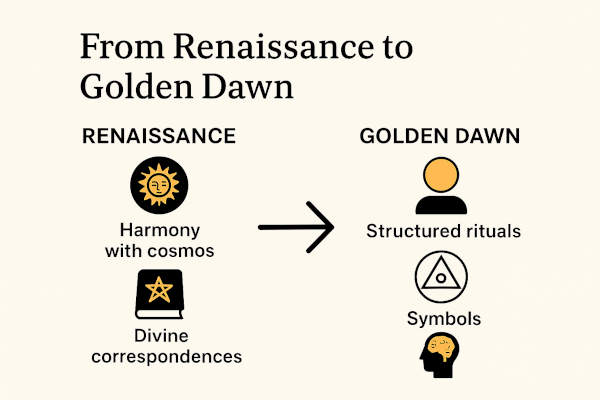
As Europe moved through the Enlightenment, the grand vision of a cosmos filled with divine correspondences lost its grip. Yet magic did not vanish—it reinvented itself. By the 19th and 20th centuries, new occult movements drew inspiration from Renaissance texts while reframing them for a secular world.
Magic became less about deciphering God’s creation and more about exploring hidden dimensions of the human self. The transition from philosopher-magicians like Ficino to occultists like Israel Regardie marks a shift from cosmic harmony to personal transformation.
A major turning point came with the Hermetic Order of the Golden Dawn, founded in the late 19th century. Its elaborate rituals, symbolic systems, and graded initiations became the blueprint for modern ceremonial magic. Members combined elements from Kabbalah, alchemy, astrology, and Christian mysticism into a single working system.
Unlike Renaissance magic, which aimed to harness natural forces, the Golden Dawn presented magic as a structured path of self-development. Its influence spread widely, shaping nearly all forms of 20th-century occultism.
Related reading: Magic in the Age of Enlightenment: How the Seventeenth Century Redefined Magic – Opens in new tab
The psychologization of rituals and symbols
One of the most striking changes in modern occultism is the move to interpret magic through psychology. What once was seen as contact with divine or cosmic powers came to be reframed as techniques for expanding consciousness.
Israel Regardie, who published Golden Dawn materials, emphasized that rituals were not about external gods but about awakening the divine within. Symbols that once carried metaphysical weight—like the Kabbalistic Tree of Life—became tools for organizing thought and mapping inner experience. In this way, magic became compatible with a disenchanted, rational world.
At the heart of this new magic lies the imagination. Rituals often revolve around visualizing light, energy, or symbolic forms flowing through the body. The famous “Middle Pillar” exercise, for example, guides practitioners to imagine divine energy descending through the Kabbalistic sefirot aligned with their own bodies.
Through such practices, the magician charges body and mind with symbolic power. Instead of manipulating cosmic forces directly, modern magicians focus on shaping inner perception—believing that changes within the imagination can ripple outward into lived reality.
Why People Still Believe in Magic
Magic survives not because it competes with science on logical grounds, but because it offers something different: lived experience. For many practitioners, rituals and symbols create powerful feelings of connection, awe, and transformation. These emotions often matter more than theoretical explanations.
Tanya Luhrmann’s research on modern magicians shows that people value the sense of spiritual depth and symbolic richness over strict logical consistency. What begins as curiosity soon becomes meaningful through the personal experiences it produces.
Living in “two worlds”: the everyday and the magical
Modern magicians often describe themselves as moving between two realities. By day, they live in a secular world shaped by science, work, and social norms. By night—or in ritual—they step into a magical world where imagination and symbolism reign. This dual existence allows them to enjoy the benefits of rational life while still embracing mystery.
Rather than seeing the two as contradictory, practitioners learn to shift perspectives depending on context. This flexibility explains how magic can thrive even in a disenchanted culture.
A key concept that makes this possible is the belief in a “magical plane.” On this level of reality, the things imagined in ritual are not just fantasies but real in their own domain. Just as computer code underlies what we see on a screen, the magical plane is thought to underlie everyday life.
By working with symbols and rituals, magicians “program” this subtle level, expecting changes to manifest in ordinary reality. The magical plane becomes a refuge for wonder, where the rules of science do not apply and creativity shapes the experience of truth.

Participation: The Secret Ingredient of Human Belief
The French philosopher Lucien Lévy-Bruhl introduced the concept of participation to explain how people experience the world in ways beyond logic. Participation means sensing a direct bond between things—so strong that distinctions between object and subject blur.
For example, in some traditions, seeing a shadow was not just noticing an image but experiencing it as part of the soul itself. Lévy-Bruhl argued that this way of thinking is not irrational but rooted in an immediate, felt connection that shapes how people live and believe.
The Renaissance doctrine of correspondences makes sense when viewed through participation. When a magus looked at a talisman and saw a god, this was not a mistake in reasoning. It was an experience of participation—an encounter where symbol and divine presence were inseparable.
Symbols were not “just” representations; they carried real power because they were part of the reality they pointed to. This explains why correspondences, rituals, and sacred images felt natural and convincing to magicians in earlier centuries.
Related reading: Sacred Sex and Modern Obsession: The Rise of Sexual Magic in the West – Opens in new tab
Why participation never disappears, even in rational societies
Participation is not limited to so-called “primitive” cultures. It is a constant in human life, appearing in art, religion, magic, and even daily habits. Children absorbed in play treat dolls as alive, not because of faulty reasoning, but because participation allows them to inhabit that reality fully.
Adults do the same when they invest deep emotion in a national flag, a wedding ring, or a lucky charm. Rationality may dominate institutions like science and education, but participation quietly endures, shaping how people find meaning. This is why magic continues to resonate: it taps into a fundamental human tendency that no amount of disenchantment can erase.

Magic Versus Instrumental Causality
Human beings naturally switch between two different modes of understanding reality. One is instrumental causality, the assumption that events happen because of material causes—fire burns because of heat, a machine runs because of gears.
The other is participation, the sense of direct, meaningful connection between things. Neither is better or worse; they simply reflect different orientations of the mind. Where science seeks causes and effects, magic looks for patterns of resonance and symbolic meaning.
These two approaches are not mutually exclusive. A child may play with dolls as if they are alive, only to laugh when a sibling pops up pretending to be a ghost—both participation and causality at work within minutes.
Adults do the same. We rely on science when fixing a car, but we may still feel that a family heirloom carries protective energy. In practice, people blend rational problem-solving with moments of symbolic or magical thinking, often without noticing. This coexistence explains why magic can thrive even in a world dominated by science.
Why rationality doesn’t erase the non-rational
Modern societies often promote instrumental causality as the official worldview, especially in schools, laboratories, and government. Yet this dominance does not mean participation disappears.
Rational explanations answer “how,” but they rarely satisfy the longing for meaning, belonging, or mystery. That is where non-rational modes of thought step in. People turn to ritual, symbolism, or magic not because they reject science, but because they seek something science does not provide. Rationality may guide daily routines, but the non-rational continues to shape the deeper layers of human life.
Related reading: Ancient Magic: From Divine Rituals to Dark Superstitions – Ancient Rome and Early Christianity – Opens in new tab
The Paradox of a Disenchanted Magic
Modernity brought relentless questioning of supernatural claims. To survive, magic reshaped itself. Instead of presenting itself as a way to manipulate hidden cosmic forces, it became framed as psychology, symbolism, and inner work.
Occultists reinterpreted ancient rituals as tools for self-development rather than proofs of external power. By aligning with modern ideas—especially psychology—magic found legitimacy in a skeptical world. This adaptability explains why it continues to attract thoughtful practitioners, even in societies that prize rationality.
The shift from cosmic harmony to personal transformation
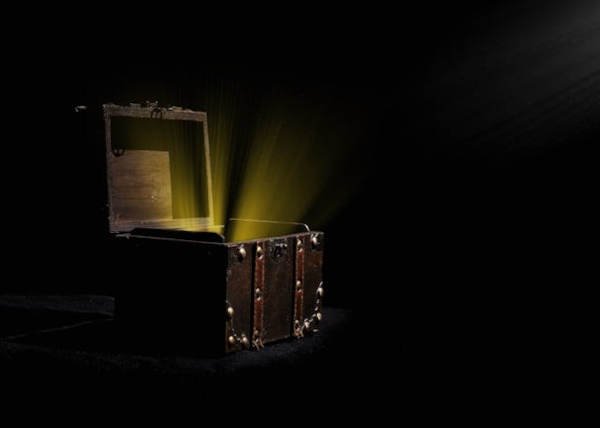
Renaissance magicians looked outward, seeking to harmonize with the divine order of the universe. Their goal was to uncover God’s design through correspondences and cosmic signs. In contrast, modern magicians turn inward.
The Golden Dawn tradition and later occult currents emphasized visualization, meditation, and the training of imagination. The focus moved from understanding the structure of creation to reshaping the self. Magic became less about deciphering the cosmos and more about unlocking human potential, creativity, and spiritual growth.
Science excels at explaining mechanisms, and religion offers collective traditions of meaning. Magic sits in a unique space between the two. It provides an individual path to wonder, allowing people to experience mystery firsthand rather than through institutional authority.
For many, it offers a language of symbols and rituals that makes personal transformation feel sacred. In this way, magic fills a gap left open by both science and organized religion: the desire for a direct, imaginative, and participatory connection with the unseen.
Related reading: The Curious Life of Montague Summers: Witch Hunter, Scholar, and Occult Enigma – Opens in new tab
Final Thoughts: A World Forever Re-Enchanted
Magic has never truly disappeared. Instead, it has survived by transforming—shifting from cosmic philosophy to personal psychology, from natural harmonies to inner symbolism. Each adaptation shows its resilience in the face of skepticism and secularization.
The idea of disenchantment suggested that rationality would strip the world of wonder. Yet the persistence of magic proves the opposite. People still crave mystery, connection, and meaning that logic alone cannot satisfy. Whether through rituals, visualization, or symbolic practices, magic continues to offer a way to engage with the unseen.
What makes magic endure is not its ability to rival science, but its ability to speak to the imagination and the emotions. It provides a sense of participation in something larger, whether cosmic or personal. And in doing so, it ensures that even in a rational age, the world remains enchanted—just in new and unexpected ways.
Source: Hanegraaff, W. J. (2003). How magic survived the disenchantment of the world (2003). Religion. https://doi.org/10.1016/S0048-721X(03)00053-8
Related reading: The Fascinating Connection Between Modern Magic and Psychology – Opens in new tab
Stay in Touch
 Join our newsletter by using the forms on this website or click here!
- Follow us on Google News
- Follow us on Facebook





Featured Photo by Ricardo E. Díaz Vega