In Numbers: Their Occult Power and Mystic Virtues by W. Wynn Westcott, the exploration of Jewish mysticism reveals a profound depth that stretches far beyond surface-level readings.
The science of numerical and linguistic mysticism is formally known as the Kabalah (also spelled Qabalah or Cabala), a word derived from the Hebrew root QBL, which means “to receive”.
Within this tradition, scholars historically divided the teachings into two primary branches: the Dogmatic Kabalah, which encompasses the theological doctrines of cosmogony and divine creation, and the Literal Kabalah, which functions as a specialized science of numbers, letter forms, and linguistic permutations.
Unlike modern alphabets used strictly for everyday communication and record-keeping, the Hebrew alphabet served a dual purpose for ancient Jewish Rabbis and later Western occultists because every letter in the script inherently doubles as a numeral.
Recognizing this structural design, the Rabbis moved past the superficial narrative value of sacred texts to discover an intricate framework of numerical concepts.
By treating letters and words as active numerical symbols, they unlocked hidden dimensions of nature, existence, divine hierarchy, and scripture that remained entirely invisible to the uninitiated eye.
Gematria: The Numerical Echoes of Scripture
As detailed in W. Wynn Westcott’s Numbers: Their Occult Power and Mystic Virtues, Gematria is a fundamental interpretive method of the Literal Kabalah that relies on the fact that every Hebrew letter carries a specific numerical value.
When the sum of the numbers comprising the letters of one word equals the sum of the letters of another word, practitioners perceive an underlying analogy and a necessary connection between them, no matter how different the words might initially appear.
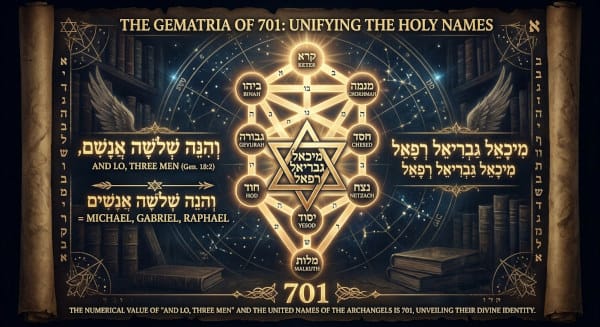
This computational approach yields fascinating insights across scriptural texts:
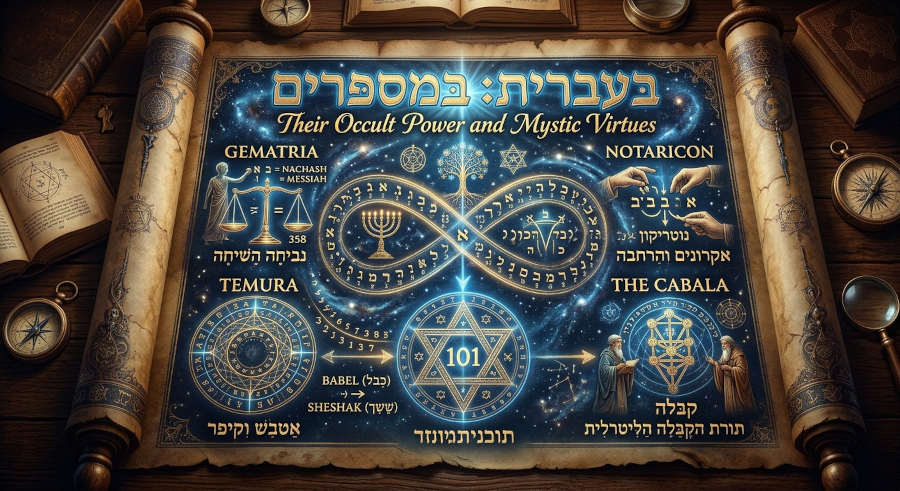
- The Angelic Triad of 701: Looking at Genesis xviii. v. 2, the phrase “and lo, three men” (Vehennah, shalisha, VHNH SHLSHH) breaks down into letter values that sum to a total of 701. Similarly, the phrase naming specific heavenly beings, “these are Michael, Gabriel, and Raphael” (Alu Mikhael Gabriel ve Raphael), converts to a numerical sum that also equals 701, leading the Rabbis to deduce that these two sets of three figures were identical entities.
- The Bridge of 358: Another striking application connects the numerical sum of 358. In Genesis xlix. v. 10, the phrase “Shiloh shall come” (Yebah Shiloh, YBA SHILH) amounts to 358. This exact same sum is shared by the word for “Messiah” (Mshych) as well as Nachash, the brass serpent lifted up by Moses in the wilderness.
Notaricon: The Shorthand of Divine Secrets
Notaricon, a term derived from the Latin notarius meaning a shorthand writer, serves as a method of both contraction and expansion within the Literal Kabalah.
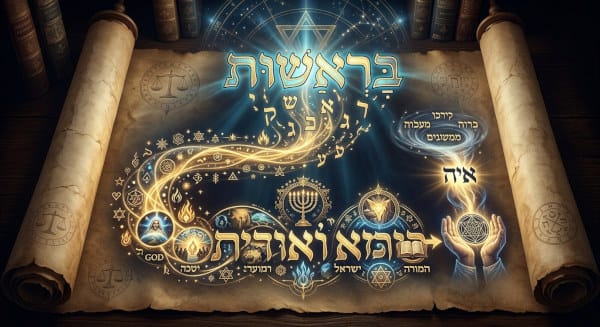
The practice operates in two primary directions:
- Acronym Formation: This involves constructing a single new word from the initial or final letters of several words in a sentence. For example, when examining Deuteronomy xxx. v. 12, Moses asks, “Who shall go up for us to heaven?” The initial letters of this sentence form the word Mylah (meaning circumcision), while the final letters form the sacred name Jehovah, poetically suggesting that the divine pointed toward heaven through circumcision.
- Sentence Expansion: Conversely, this direction constructs a full sentence out of the individual letters that compose a given root word. A famous instance of this is found in the first six letters of Genesis, Berasit (translated as “In the beginning” or “In wisdom”), which serve as the initials for a sentence revealing that God foresaw Israel accepting the Torah.
Temura: Permutation and Ciphers
Temura refers to the art of permutation within the Literal Kabalah. It involves transposing the letters of a word according to strict, systematic rules, or replacing them with alternative letters based on defined schemes to generate entirely new words and hidden ciphers.
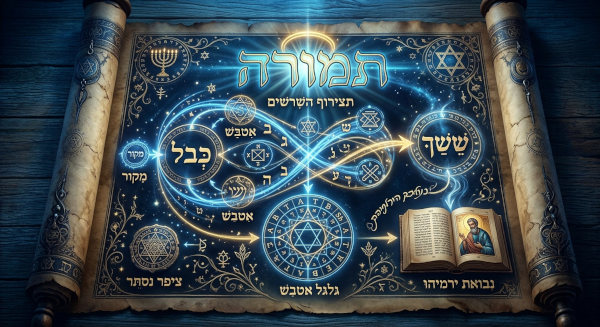
The Rules of Substitution
Practitioners of Temura utilized various structured methods to substitute and rearrange letters:
- Atbash and the Combinations of Tziruph: One of the most recognized methods is Atbash. In this system, the 22-letter alphabet is split in half, and the two halves are placed one over the other in reverse order (pairing A with T, B with Sh, and so on). This is part of a broader set of 22 permutation variations known collectively as the “combinations of Tziruph”.
- Historical Examples: Applying these substitution rules yields notable historical and scriptural connections. For instance, by utilizing the Atbash cipher, the word Babel transforms directly into Sheshak (ShShk)—a substitution famously employed by the prophet Jeremiah in Jeremiah xxv. v. 26.
End Words
Through the intricate tools of Gematria, Notaricon, and Temura, the Literal Kabalah transformed sacred texts far beyond a simple surface-level narrative into a multi-layered matrix of divine philosophy.
Gematria linked seemingly unrelated words through the shared mathematical sums of their letters, Notaricon acted as a linguistic shorthand of contraction and expansion to reveal hidden acronyms and prophecies, and Temura unlocked ciphers through systematic letter permutations and substitutions.
These computational and linguistic methods served a vital function for ancient and medieval thinkers.
By encoding deep philosophical doctrines directly into the numerical and structural properties of language, mystics and Jewish Rabbis were able to preserve and pass down hidden truths across generations while keeping them securely veiled from the uninitiated.
Continue Your Journey of Timeless Wisdom
Discover more powerful ideas distilled from classic books that shaped minds and changed lives.
👉 Explore the “Drops of Wisdom” collection
Stay in Touch
 Join our newsletter by using the forms on this website or click here!
- Follow us on Google News
- Follow us on Facebook