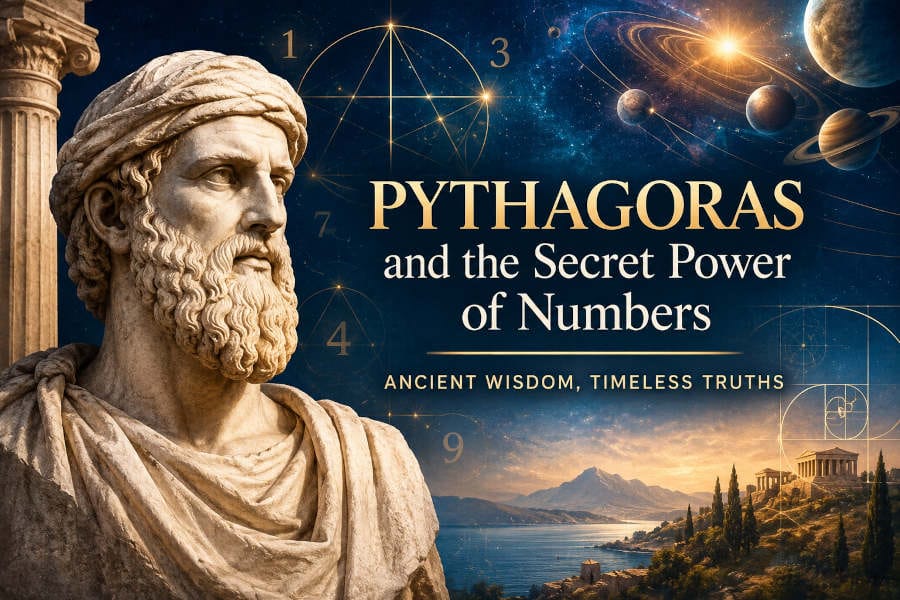
Pythagoras, revered as one of the greatest philosophers of ancient Europe, was born around 580 B.C. either at Samos, an island in the Aegean Sea, or at Sidon in Phoenicia. Driven by a profound dissatisfaction with the limits of local knowledge, he embarked on an extensive pilgrimage in search of wisdom that spanned Hindostan, Egypt, Persia, Crete, and Palestine. Through these travels, he successfully absorbed both the exoteric knowledge and the inner esoteric wisdom of each culture.
Finding it impossible to establish a college in his native land due to the opposition of the ruler Polycrates, Pythagoras migrated to Crotona—a Dorian colony in southern Italy—where he founded his famous Society of Students. For nearly forty years, in secret conclave, he taught an intricate occult wisdom gathered from Brahmin priests, Egyptian hierophants, Chaldean magi, and Hebrew rabbis.
Numbers as Hieroglyphic Symbols
To the modern mind, numbers are abstract tools used primarily for counting, measuring, and calculation. For Pythagoras and his disciples, however, numbers occupied a vastly elevated tier of existence. Porphyry noted that “the numerals of Pythagoras were hieroglyphic symbols, by means whereof he explained all ideas concerning the nature of things”.
Rather than viewing mathematics as a detached science, the Pythagoreans perceived numerals as living keys to the universe. They formed the bedrock of a grand cosmic scheme, explaining both physical and spiritual cosmogony, as well as the evolution of humanity. In the eyes of the Italian school, numbers were not invented; they were discovered as the inherent structural blueprints of reality.
This article is based on W. Wynn Westcott’s book Numbers: Their Occult Power and Mystic Virtues (1911). You can read the original book [here].
The Core Tenet: Numbers as the Essence of Realities
The foundational principle of Pythagorean mathematics and philosophy asserts that the principles governing numbers are the principles of all real existences.
Because numbers serve as the primary constituents of mathematical quantities while simultaneously presenting profound analogies to universal truths, the school inferred that the elemental components of numbers must logically be the elements of all realities.
Under this worldview, every object, planet, human faculty, and abstract idea was intimately bound to a specific number, transforming mathematics into a profound metaphysical language.
The Architecture of Parity: Odd vs. Even
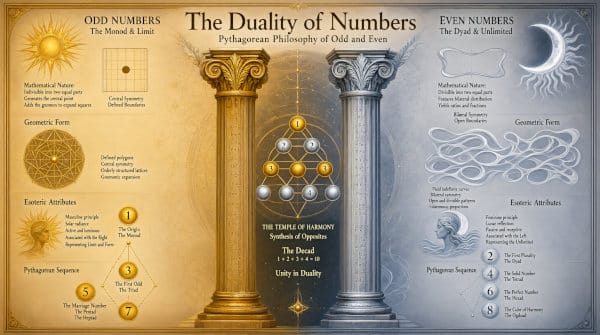
In the foundational mathematics of the Pythagorean school, the primary division of numbers is split between the Even and the Odd. This division was far more than an arithmetic classification; it served as a fundamental moral and metaphysical lens through which the ancients viewed creation.
- The Odd Number: Initiated by the Monad, odd numbers were esteemed as masculine, definite, orderly, and closely tied to the principle of good. When an odd number is divided into two equal parts, it always leaves a monad (a single unit) in the middle. Because the father was traditionally esteemed above the mother in ancient hierarchy, odd numbers were favored and frequently dedicated to the greater gods.
- The Even Number: Initiated by the Dyad (two), even numbers were viewed as feminine, indefinite, unknown, inordinate, and fundamentally associated with matter and division. An even number divides cleanly into two equal parts without leaving a monad between them. Even numbers were traditionally assigned to inferior and terrestrial deities.
Mathematical and Philosophical Distinctions
Beyond the basic split of parity, the ancient sages sorted numbers into complex classifications that reflected deeper philosophical dualities:
- Odd Number Subdivisions: Odd numbers were categorized into three distinct varieties. First and incomposite numbers (such as 3, 5, 7, and 11) cannot be measured by any number other than unity, mirroring pure generation from the source. Second and composite numbers (such as 9, 15, and 21) are composed of other numbers and contain “foreign parts,” rendering them divisible by other integers.
- Even Number Subdivisions: Even numbers were similarly categorized into evenly even, evenly odd, and unevenly even numbers based on how far their divisions could be halved down toward unity or arrested mid-process.
- The Metaphysical Reflection: These mathematical properties mirrored the ancient belief that goodness is defined, bounded, and structured, whereas evil and matter are formless, indefinite, and infinite. Through these structural rules, the architecture of numbers served as a mirror for the moral and structural forces of the universe.
The Emulators of Virtue: Perfect, Deficient, and Superabundant Numbers
In the arithmetic philosophy of the Pythagoreans, even numbers were divided into three moral categories based on the sum of their proper factors (aliquot parts):
- Perfect Numbers: A number is classified as perfect when the sum of all its proper divisors equals the exact value of the number itself. For instance, 6 has factors of 1, 2, and 3, which sum to 6 (1 + 2 + 3 = 6). Similarly, 28 is formed by the sum of its divisors 1, 2, 4, 7, and 14 (1 + 2 + 4 + 7 + 14 = 28).
Virtue as a Middle Limit
The Pythagoreans mapped their ethical theory of human behavior directly onto these mathematical properties:
- Emulators of Virtue: Perfect numbers embody the principle of the “middle limit,” standing in ideal equilibrium between two opposing extremes. Just as moral virtue was viewed by ancient thinkers as a balanced midpoint between excess and deficiency, perfect numbers exist in exact harmony with their constituent parts.
- Contrasted with Vices:
- Superabundant (or Superperfect) Numbers: Numbers whose parts, when summed, exceed the whole (such as 12, whose factors 1 + 2 + 3 + 4 + 6 = 16). These were likened to monsters like Briareus, the hundred-handed giant, representing gross excess and overabundance.
- Deficient Numbers: Numbers whose parts sum to less than the whole (such as 14, whose factors 1 + 2 + 7 = 10). These were compared to the one-eyed Cyclops, symbolizing lack and defect.
Like vices, which are infinite, disorderly, and abundant in human life, deficient and superabundant numbers dominate the mathematical landscape.
Rarity in Nature
A striking feature noted by ancient philosophers was the extreme scarcity of perfect numbers within the natural numerical sequence:
- Between 1 and 10, there is only one perfect number (6).
- Between 10 and 100, there is only one (28).
- Between 100 and 1,000, there is only one (496).
- Between 1,000 and 10,000, there is only one (8,128).
This rarity reinforced the Pythagorean belief that true virtue is rare, orderly, and divine, whereas imperfection and disharmony are common and easily multiplied.
Mapping the Cosmos: Music, Geometry, and the Human Soul
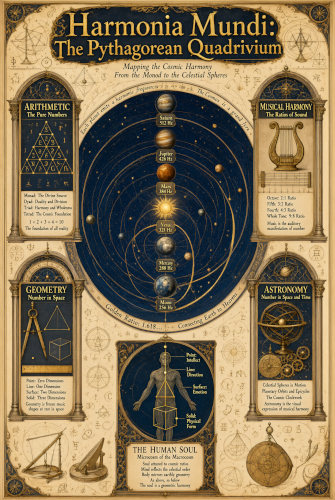
For the followers of Pythagoras, true knowledge was systematically organized into a comprehensive fourfold discipline that encompassed all aspects of physical and abstract reality. This curriculum was divided into two major branches: the science of numbers and the theory of magnitude.
- The Science of Numbers: This branch comprised arithmetic (the study of numbers in themselves) and musical harmony (numbers applied to ratios and sounds).
- The Theory of Magnitude: This branch was subdivided into geometry (magnitude at rest) and astronomy (magnitude in motion).
Together, these four pillars formed the universal framework through which the Italian school sought to decode the creation.
The Music of the Spheres
One of the most captivating doctrines of the Pythagorean tradition is the concept of the “Music of the Spheres”. Simplicius notes in his commentary on Aristotle that Pythagoras and his followers claimed to actually hear an ineffable harmonic sound produced by the continuous motion of the planets through space.
By observing these harmonic frequencies and intervals, the philosophers calculated the mathematical ratios governing the relative distances and sizes of the Sun, Moon, Venus, and Mercury. While critics like Aristotle questioned how such a sound could go unnoticed by ordinary ears, later esoteric philosophers suggested that purified senses, heightened probity, or spiritual elevation could attune an adept to perceive sights and cosmic sounds entirely imperceptible to those still in material bondage.
Psychology and Hierarchical Types
The Pythagorean worldview extended far beyond physical and celestial mechanics, mapping human psychology, abstract mental faculties, and geometric forms onto a strict numerical hierarchy:
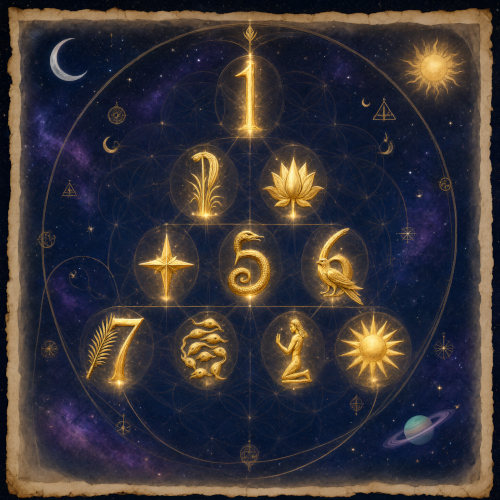
- The Monad (1): Associated with the geometric point, the Monad served as the type for pure intuitive knowledge.
- The Dyad (2): Associated with the line, the Dyad corresponded to reason and causation.
- The Triad (3): Associated with the superficies (surface), the Triad represented imagination (form or rupa).
- The Tetrad (4): Associated with the solid, the Tetrad represented the sensation of material objects.
By tying every individual planet, human faculty, and cosmic essence back to a specific numerical root, the Pythagoreans forged a profound link between the inner architecture of the human soul and the grand geometry of the universe.
End Words
The philosophy of Pythagoras and his followers invites a profound re-evaluation of how we perceive reality. Rather than viewing the universe as a random collection of physical matter and cold statistics, the Pythagorean worldview envisions cosmos as a grand harmonic equation.
In this framework, numbers cease to be mere quantitative tools; instead, they act as living symbols, hieroglyphs, and structural blueprints.
Physical reality and spiritual essence seamlessly merge, as the fundamental properties of numbers—such as parity, geometric dimensions, and perfect proportions—govern both the outer movements of the celestial spheres and the inner architecture of the human soul.
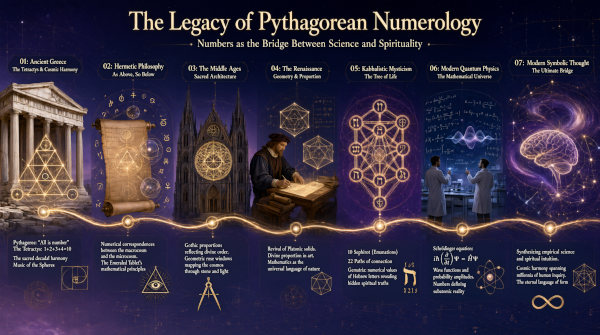
The modes of thought introduced by the Italian school left an indelible mark on intellectual history. Their intricate synthesis of mathematics, philosophy, and mysticism created ripples that endured across millennia.
The principles pioneered by Pythagoras were later absorbed and reinterpreted by subsequent Western esoteric traditions, Hermetic philosophy, Kabalistic scholars, and modern symbolic thinkers.
By treating numbers as keys to universal truth, the Pythagorean tradition established a timeless bridge between science and spirituality, proving that the search for mathematical order is, at its core, a quest for the divine.
Continue Your Journey of Timeless Wisdom
Discover more powerful ideas distilled from classic books that shaped minds and changed lives.
👉 Explore the “Drops of Wisdom” collection
Stay in Touch
 Join our newsletter by using the forms on this website or click here!
- Follow us on Google News
- Follow us on Facebook