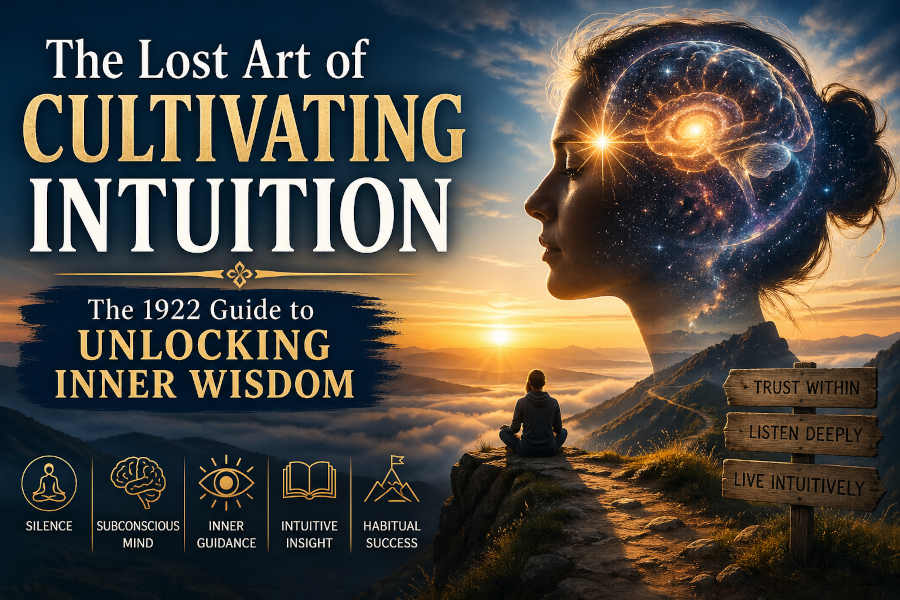
While we often celebrate the conscious mind as our greatest asset, relying solely on logic can create a significant barrier to deeper understanding. Based on the timeless principles found in the 1922 classic “The Magic of the Mind,” we learn that while the reasoning mind is a necessary tool for navigating the material world, it often generates a “storm” of mental chatter that drowns out profound insights.
By focusing strictly on what can be seen or measured, logic limits you to the surface of life and frequently misses the subtle, powerful truths that reside just beneath the threshold of awareness.
The text defines intuition as a “disinterested guide”—a faculty that operates without the personal bias, anxiety, or emotional struggle associated with conscious reasoning. Unlike your conscious mind, which often wavers between hope and fear, your intuition operates with the calm, mechanical certainty of a natural law.
It is a voice that speaks from the depths of your subconscious, offering wisdom untainted by the prejudices of your external environment. Because it does not engage in the exhausting work of logical debate, it remains a steady hand even when your conscious thoughts are clouded by confusion.
Accessing this inner voice provides a remarkable “short-cut” to solutions that are often entirely out of reach for the analytical mind. While reason must laboriously climb from one step to the next to reach a conclusion, the methods preserved in “The Magic of the Mind” show that intuition can arrive at the destination instantly.
It bypasses the slow machinery of conscious thought to deliver a finished “flash” of insight that is both accurate and complete. By learning to trust this faculty, you gain a massive advantage; you are no longer forced to grope in the dark, but instead tap into a reservoir of knowledge that points you toward success with unerring precision.

Distinguishing Intuition from Logic
The conscious mind is a tireless debater. As the “sentinel” at the gate of your awareness, its primary mode of operation is reasoning, which often involves a back-and-forth struggle of pros and cons. It weighs evidence, looks for flaws, and frequently stalls in the face of uncertainty. This “active” part of your mind is designed to argue its way toward a conclusion, often resulting in doubt or hesitation.
In sharp contrast, your subconscious mind does not engage in debate. It occupies a “passive” state that simply knows. Because the subconscious is your link to a deeper storehouse of wisdom, it doesn’t need to struggle with logic to find the truth. While your conscious mind is busy arguing at the surface, your subconscious is already in possession of the answer, waiting for a moment of quiet to present it to you.
Breaking Free from the Five Senses
Logic is inherently limited because it is bound by what you can perceive through your five physical senses. Your reasoning mind relies on material observation—what you can see, hear, touch, taste, and smell—to form its judgments. This creates a narrow perspective that is confined to the physical world and its immediate surroundings. If a solution isn’t visible or audible, logic often concludes it doesn’t exist.
Intuition, however, draws from a much grander source: the “Universal Mind.” This is the “First Great Cause” or “Divine Spirit” that permeates everything. By tapping into this universal dynamo, intuition accesses information that transcends your physical location and material limitations. It isn’t restricted by the “stone walls” of the physical world; it operates in a realm where knowledge is absolute and unrestricted.

The Power of Spontaneous Conviction
One of the most recognizable signs of intuition is the “flash of insight.” Unlike a logical conclusion, which is reached through a visible chain of reasoning, intuitive conviction arrives spontaneously and complete. You don’t see the steps that led to the answer; you simply find yourself in possession of the truth. It is a “phenomenal” experience where a conviction “wells up” from the subconscious and crosses the threshold of consciousness.
This spontaneous conviction is often far more accurate than any result reached through laborious study. It is the “secret voice” that speaks clearly when the clamor of the external world is silenced.
When you feel a sudden, deep certainty about a choice—unsupported by immediate facts but impossible to ignore—you are experiencing the subconscious mind communicating a finished truth. Recognizing these flashes allows you to move with a speed and confidence that logic alone can never provide.
| Aspect | Logic (Conscious Mind) | Intuition (Subconscious Mind) |
| Speed | Slow, step-by-step | Instant, “flash” insight |
| Process | Analyzes, debates, compares | Knows without reasoning |
| Basis | Sensory data (5 senses) | Subconscious + “Universal Mind” |
| Emotional State | Doubt, hesitation, conflict | Calm, certain, neutral |
| Effort Required | High mental effort | Effortless reception |
| Output | Conclusions | Convictions |
The Phenomenal Sensory Perception of the Subconscious
The subconscious mind operates with a set of “phenomenal” sensory powers that far exceed the capabilities of our physical eyes and ears. While our conscious mind is limited by the biological constraints of the body, the book suggests that the inner mind possesses faculties akin to clairvoyance and telepathy.
These powers allow the subconscious to perceive facts and events that are hidden from the conscious sentinel. By tapping into this deeper layer of mentality, you are not merely guessing at the truth; you are utilizing a refined sensory system that can “see” through obstacles and “hear” thoughts across great distances.
This is why intuition often feels like a sudden awareness of something that shouldn’t be known through traditional means—it is the result of these hidden senses gathering information from the “Universal Mind.”
Continue Your Journey of Timeless Wisdom
Discover more powerful ideas distilled from classic books that shaped minds and changed lives.
👉 Explore the “Drops of Wisdom” collection
The Vast Mountain of Hidden Data
Every single impression, sight, sound, and thought you have ever experienced is preserved with perfect accuracy within the subconscious. At the same time, your conscious memory may be fleeting or prone to forgetting, but the subconscious acts as a permanent reservoir of knowledge.
The book describes this as a “mountain” of data, with the conscious mind representing only the tiny peak visible above the water. This massive storehouse provides the raw material for your intuition. When you face a new challenge, your intuition doesn’t just pull an answer from thin air; it lightning-fast sifts through this exhaustive archive of past experiences and universal truths to deliver the most effective solution. Because this data exists below the threshold of consciousness, it remains a powerful, untapped resource until you learn to invite it upward.
One of the most fascinating aspects of the subconscious is its ability to act as a “Double” that performs complex creative and intellectual tasks. This phenomenon occurs when the conscious mind steps aside, allowing the inner workshop to take over the primary labor.
Famous authors, composers, and inventors often describe a feeling where their work seems to write or compose itself. Robert Louis Stevenson, for instance, spoke of “Little People” or “Brownies” who worked out his stories while he was asleep or in a dreamlike state.
This “Double” is the subconscious mind at work, finishing tasks with a level of genius and speed that the reasoning mind could never achieve through sheer effort. When you stop “trying” to force a solution and instead hand the problem over to your inner self, this creative force begins to operate.
It organizes thoughts, finds the perfect words, and constructs inventions, presenting the finished product to your conscious awareness as if it were a gift from another person. By understanding this relationship, you can move from being a laborer of the mind to a master director of your internal genius.
| Indicator | True Intuition | Emotional Impulse |
| Feeling | Calm, quiet certainty | Urgent, intense, reactive |
| Origin | Subconscious | Ego / fear / desire |
| Tone | Neutral, “disinterested” | Attached to outcome |
| Persistence | Stable over time | Fluctuates quickly |
| Physical Sensation | Grounded, clear | Tense, restless |
| Decision Style | Feels obvious | Feels pressured |
The Role of Passivity and Physical Relaxation
One of the greatest hurdles to accessing your inner wisdom is the tendency to “try too hard.” When you approach a problem with intense conscious effort, your reasoning mind becomes highly active and alert, effectively tightening the “Threshold of Consciousness.”
This mental strain creates a state of tension that blocks the upward flow of information from your subconscious. Because intuition is a passive faculty, it cannot be forced or bullied into appearing. The more you struggle and “grope in the dark” with your conscious intellect, the further you push away the very insights you seek. To find the answer, you must often stop looking for it with your analytical eyes.
The Technique of Physical Muscular Relaxation
To lower the barriers of the reasoning mind, you must learn the deliberate practice of physical relaxation. By softening the body, you signal to the conscious sentinel that it is safe to stand down. Start by finding a quiet place and sitting or lying in a comfortable position. Close your eyes and systematically release the tension in your muscles—starting from your toes and moving up through your legs, torso, arms, and finally the face.
As your body becomes heavy and still, the “Threshold of Consciousness” begins to lower. This physical passivity acts as a mechanical trigger that shifts your mental state from an active, defensive mode to a receptive one. In this state of total relaxation, the subconscious mind can more easily transmit its convictions to your conscious awareness, allowing hidden truths to “well up” without resistance.
Silence as the Conductor of Intuition
In the bustle of daily life, our mental atmosphere is often filled with the “noise” of external suggestions, social pressures, and logical debates. This clamor makes it nearly impossible to hear the “secret voice” of the subconscious. Stillness acts as a conductor for intuitive thought; it provides the quiet environment necessary for subtle insights to be recognized.
By retreating into silence, you strip away the distractions that keep the conscious mind focused outward. In this profound quiet, the “disinterested guide” of intuition becomes audible. It is not that the voice is quiet, but rather that our lives are often too loud. When you master the art of being still, you provide the space for the “Universal Force” to speak clearly, guiding you toward the right path with a certainty that noise could never provide.
| Technique | What You Do | Why It Works | When to Use |
| Physical Relaxation | Release muscle tension progressively | Lowers mental resistance | When overthinking |
| Silence | Remove external noise | Reduces mental chatter | Daily practice |
| Morning Hour | Stay still after waking | Conscious mind is inactive | Early morning |
| Receptive Waiting | Listen instead of thinking | Encourages subconscious flow | After asking a question |
| Journaling Insights | Write immediately | Anchors intuitive ideas | Right after insights |
The “Morning Hour” Meditation
There is a specific time of day when the veil between your two minds is at its thinnest: the moments immediately following your awakening. During this “Morning Hour,” the conscious sentinel has not yet fully resumed its busy post of analyzing, worrying, and judging. Your brain is still bathed in the quiet energy of the subconscious, making it a “magical” window for intuitive reception.
In this semi-conscious state, you are naturally more receptive to the higher vibrations of the Universal Mind. Because the reasoning faculty is still drowsy, it cannot block the delicate impulses trying to cross the threshold. This is the prime time to catch the insights that were processed in your “underground workshop” while you slept.
The Art of Receptive Waiting
To master the “Morning Hour,” you must practice the art of receptive meditation. Unlike traditional prayer or active thinking where you are “sending” messages out, this practice requires you to simply wait and listen. After you wake, stay still and keep your eyes closed if possible.
Instead of immediately planning your breakfast or checking your schedule, maintain a state of passive expectancy. You are essentially holding an open vessel, waiting for ideas to “well up” from the deep reservoir of your subconscious. This “receptive waiting” allows the secret voice of intuition to speak. It may arrive as a sudden solution to a problem, a creative spark, or a clear feeling about a decision you need to make.
If you want to learn more about Subconscious Reprogramming and the Manifestation process. Check out my suggestions on manifestation courses and books. – Opens in new tab
The insights gained during these quiet moments are often as fleeting as dreams. As soon as you fully engage with the material world—by speaking, moving, or checking your phone—the conscious mind snaps back into a dominant, critical mode.
This active “reasoning sentinel” is quick to dismiss intuitive flashes as mere imagination or nonsense. To prevent this, you must “record the harvest” immediately. Keep a pen and paper or a recording device by your bedside. By documenting these flashes of insight the moment they arrive, you anchor them into your conscious reality. This practice not only preserves the wisdom you’ve received but also signals to your subconscious that you value its guidance, encouraging even more frequent and powerful communications in the future.

Fasting and the Refinement of the Mental Inlet
The relationship between your physical body and your mental faculties is profound and direct. When your physical system becomes “clogged” through overindulgence or poor habits, your mental perception inevitably becomes clouded. The book suggests that a heavy or sluggish body weighs down the “sentinel” of the conscious mind and muddies the waters of the subconscious.
This physical congestion acts as a barrier, making it difficult for subtle intuitive signals to reach your awareness. To maintain a sharp and clear mentality, you must treat your body as the delicate instrument it is. By keeping the physical temple clean, you remove the “fog” that prevents you from seeing the opportunities and truths that are always present around you.
The Phenomenal Clarity of Temporary Fasting
To sharpen your senses and heighten your intuitive perception, the book recommends the practice of temporary fasting. When you abstain from food for a short period, you allow your body to divert its energy away from the labor of digestion and toward the refinement of your mental faculties.
This practice is described as a way to “sharpen the senses,” making you more sensitive to the fine vibrations of thought. Fasting acts as a mental house-cleaning that strips away the distractions of physical appetite. Many of the world’s greatest thinkers have used this method to gain a “clarity of vision” that logic alone could never provide, allowing them to solve complex problems with surprising ease.
Purifying the Channel for the Universal Force
Your personal mind is essentially an “inlet” through which the Universal Force or Divine Spirit flows. To receive the maximum amount of power and guidance from this source, your “inlet” must be kept open and pure. Physical discipline, including fasting and moderation, serves as a way to purify this channel.
When you are physically disciplined, you are not just improving your health; you are making yourself a more perfect conductor for the “First Great Cause.” By refining your physical nature, you allow the light of the Universal Mind to shine through you with greater intensity. This alignment ensures that your intuition is not blocked by physical sloth, but is instead powered by the limitless energy of the Oversoul.

Integrating Intuition into Daily Life and Business
Integrating intuition into your daily life turns you into a “practical mystic”—someone who uses spiritual laws to achieve material results. In the fast-paced world of business and social interaction, logic often moves too slowly to keep up with shifting opportunities. By trusting your intuitive “hunches,” you can navigate professional decisions with a speed that baffles those who rely solely on spreadsheets and debate.
These flashes of insight often point toward the integrity of a partner or the hidden potential of a new project before the facts ever surface. When you apply this inner guidance to your career, you aren’t just guessing; you are utilizing a refined sensory system that detects the “motive power” behind every situation.
Distinguishing True Intuition from Emotional Impulse
A critical skill in mastering the mind is learning to “test the voice” to ensure you are following a true intuitive lead rather than a fleeting emotional impulse. The book suggests that true intuition arrives with a sense of calm, “disinterested” certainty. It does not argue, and it is not born from excitement, greed, or fear. If a thought is accompanied by heavy emotional agitation or a desperate desire for a specific outcome, it is likely an impulse of the conscious mind rather than an insight from the subconscious.
To distinguish the two, observe the quality of the message; an intuitive lead feels like a solid, quiet conviction that “wells up” from within, whereas an impulse feels like a loud, external pressure trying to force a decision.
The ultimate result of integrating these practices is the development of a sense of “Unerring Guidance.” As you become more adept at filtering out the noise of the external world and listening to the subconscious, your life begins to move with a new, effortless rhythm.
You no longer feel like you are groping in the dark or constantly reacting to crises. Instead, you walk with the confidence of someone who has a secret map of the terrain. This alignment leads to what the text calls habitual success—a state where prosperity and health become the rule rather than the exception. By living in harmony with your “Higher Self,” you transform from a victim of circumstance into a “Master of Fate.”
| Concept | Key Takeaway |
| Intuition | Instant, subconscious knowing |
| Logic | Slow, analytical reasoning |
| Access Method | Relaxation + silence |
| Best Time | Morning state |
| Key Skill | Distinguishing calm vs emotional signals |
| Result | Faster, clearer decisions |
Conclusion: The Guidance of the Oversoul
It is a common misconception to view intuition as a rare, supernatural gift bestowed upon only a chosen few. In reality, the book asserts that this “secret voice” is a natural birthright belonging to every human being. Because your personal mind is an inlet to the “Universal Mind” or “Divine Spirit,” you have a legitimate, divine right to access the knowledge contained within that infinite source.
You are not reaching for something outside of yourself; you are simply clearing the channel to your own higher faculties. By recognizing that intuition is a biological and spiritual certainty, you move away from the fear of being “unlucky” and step into the confidence of a law-abiding universe where wisdom is always available to those who prepare for it.
The final lesson of this mental journey is a call to end the struggle of “groping in the dark.” For too long, many have relied solely on the flickering candle of human reason, trying to find their way through the complexities of life by logic alone. You are invited to stop this exhausting labor and instead trust the “Light of the Mind.” This light is the steady, illuminating power of your subconscious connected to the Universal Force.
When you follow the practices of relaxation, silence, and receptive meditation, you allow this light to show you the path clearly. Do not let the “baubles for which men die”—the temporary material distractions—blind you to the enduring power of your inner guide. By trusting your “disinterested guide,” you become a master of your own fate, walking a path of habitual success and profound peace.
Reading is powerful—but applying timeless knowledge is life-changing. Dive into the original book that inspired these ideas and start reprogramming your mind today.
👉 Access the full PDF of “The Magic of the Mind” instantly
Stay in Touch
 Join our newsletter by using the forms on this website or click here!
- Follow us on Google News
- Follow us on Facebook